Text and photographs by Pierre Amrouche
If a foreigner knows where the “tîgban” lies, it’s because the village people have shown him (local saying)
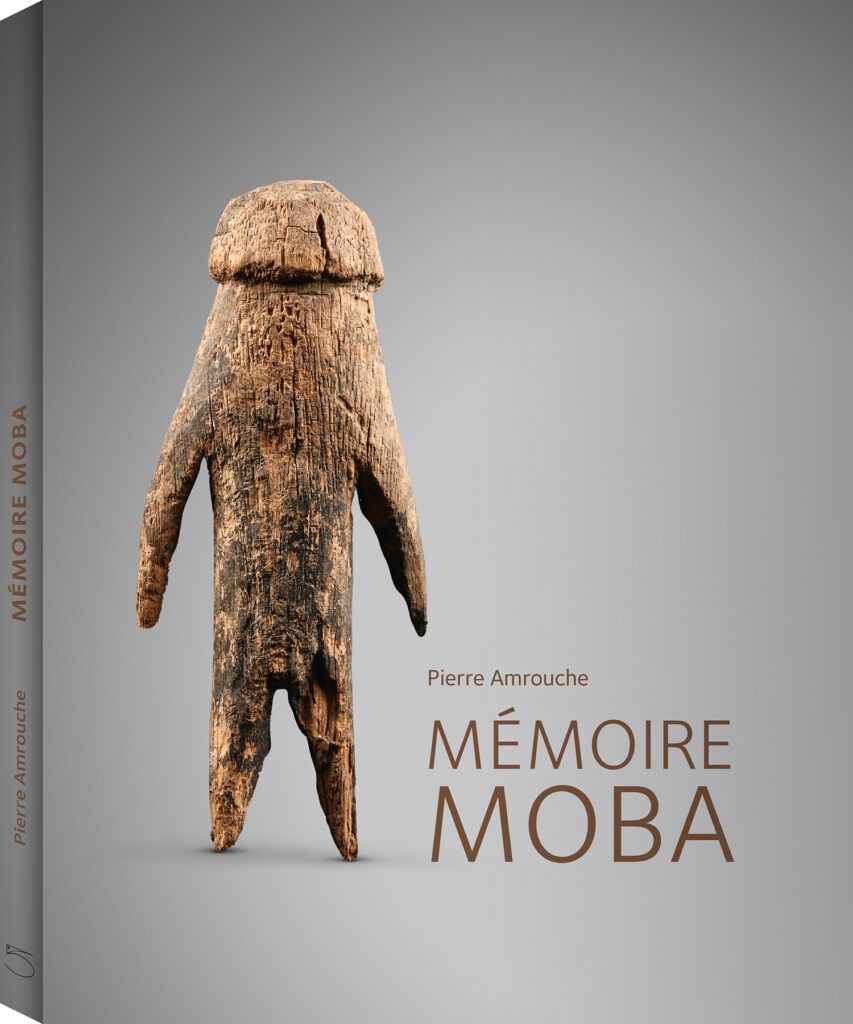
Pierre Amrouche travelled the length and breadth of Moba country from 1991 to 2023, collecting records and photographs. This book encapsulates Moba culture. Located in the far north of Togo and Ghana, Moba country begins with a plateau scored by numerous valleys that then blends into the huge Volta plain. The Moba occupy this region of savannah woodland, dotted with rocky hills where the baobab finds its ideal habitat.
This people is part of the larger Gourma ethnic group, which migrated here in waves from Burkina Faso. Moba society is essentially rural; members live around a main dwelling consisting of an enclosure bounded by a series of circular thatched adobe huts. Millet and sorghum are their subsistence crops, while they also rear a few small animals.
Moba woodcarvers make three types of anthropomorphic figures known as tchitchiri. These represent either specific ancestors, belonging to the genealogy of a particular family or clan, or generic ancestors of human beings as a whole. Each type of statue has a specific function. The style does not vary much and is quite distinctive. While made in the likeness of the human form, these striking, slender figures are notably abstract.
The Moba also make bronze and copper rings bristling with spikes that symbolise the sun’s rays, which they generally wear as pendants.
Whether it has a religious or more broadly social function, Moba art is above all utilitarian. The Moba artist excels in the role assigned to him: expressing the maximum while depicting the minimum; in short, going straight to the essence.
Pierre Amrouche, an internationally renowned expert in ethnic art, photographer and writer, was born in Paris on 25 November 1948. He is the son of Jean Amrouche, a Kabyle poet, literary critic, essayist and journalist, and Suzanne Maria Virginie Molbert, a professor of classics from an old French family in Algeria. Strongly influenced by the dual roots of his father’s cultural identity, and wishing to keep in touch with his origins, he holds great store by his dual French and Algerian nationality.